Views: 204868


from www.oas.org
NATIONAL ANTHEM OF THE UNITED STATES
“The Star Spangled Banner”
Francis Scott Key (1814)Oh, say, can you see, by the dawn's early light, What so proudly
we hail'd at the twilight's last gleaming? Whose broad stripes and
bright stars, thro' the perilous fight,O'er the ramparts we watch'd, were so gallantly streaming?
And the rockets' red glare, the bombs bursting in air,
Gave proof thro' the night that our flag was still there.O say, does that star‐spangled banner yet wave
O'er the land of the free and the home of the brave
mona rose's
Star Spangled Banner As You've Never Heard It
The Real Story Behind the Star-Spangled Banner, the Flag That Inspired the National Anthem
How the flag that flew proudly over Fort McHenry in September 1814 made its way to the Smithsonian

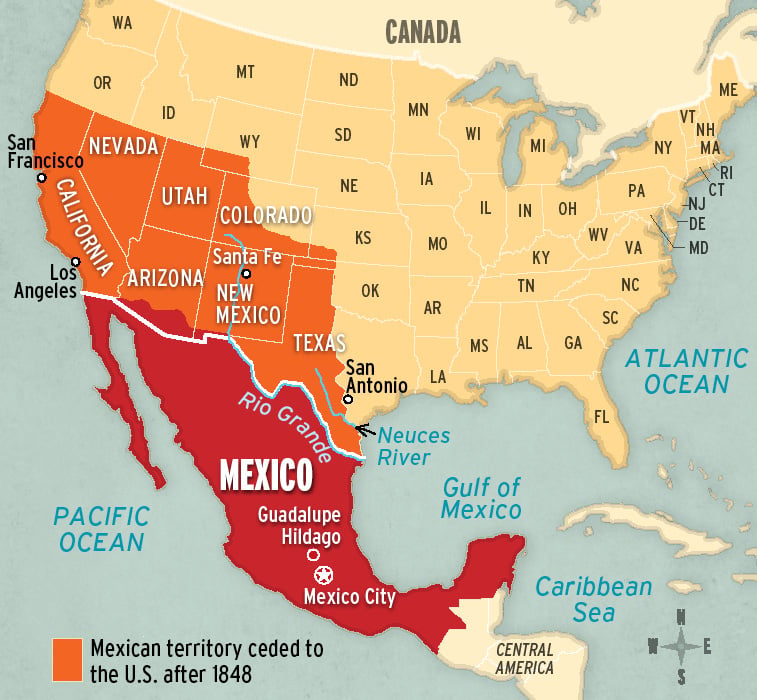
The quickest recap of the pre-civil war politics of the time dividing congress, the north opposed bringing Texas, a slave state, into the union (They were the Whig party at the time [1833-1856]). The south was for it (They were the Democrats). This would define the politics of the time and here are some of those voices from history.
https://en.wikipedia.org/wiki/James_K._Polk
https://en.wikipedia.org/wiki/Whig_Party_(United_States)
"[Mexico] has invaded our territory and shed American blood upon American soil," - President James K. Polk
"There is more selfishness and less principle among members of Congress...than I had any conception of, before I became President of the U.S." - President James K. Polk
"Generally, the officers of the army were indifferent whether the annexation was consummated or not; but not so all of them. For myself, I was bitterly opposed to the measure, and to this day, regard the war, which resulted, as one of the most unjust ever waged by a stronger against a weaker nation. It was an instance of a republic following the bad example of European monarchies, in not considering justice in their desire to acquire additional territory." -Ulysses S. Grant, Personal Memoirs of General U. S. Grant (1885), p. 16
"The Southern rebellion was largely the outgrowth of the Mexican war. Nations, like individuals, are punished for their transgressions. We got our punishment in the most sanguinary and expensive war of modern times." -Ulysses S. Grant, Personal Memoirs of General U. S. Grant (1885), Chapter 3
"Any people anywhere being inclined and having the power have the right to rise up and shake off the existing government, and form a new one that suits them better. This is a most valuable, a most sacred right — a right which we hope and believe is to liberate the world. Nor is this right confined to cases in which the whole people of an existing government may choose to exercise it. Any portion of such people that can may revolutionize and make their own of so much of the territory as they inhabit... Military glory,—that attractive rainbow that rises in showers of blood." -Abraham Lincoln, speech in the United States House of Representatives opposing the Mexican war (12 January 1848)
"Allow the President to invade a neighboring nation, whenever he shall deem it necessary to repel an invasion, and you allow him to do so, whenever he may choose to say he deems it necessary for such purpose, and you allow him to make war at pleasure. Study to see if you can fix any limit to his power in this respect, after having given him so much as you propose. If, to-day, he should choose to say he thinks it necessary to invade Canada, to prevent the British from invading us, how could you stop him? You may say to him, "I see no probability of the British invading us" but he will say to you, "Be silent; I see it, if you don't." The provision of the Constitution giving the war making power to Congress was dictated, as I understand it, by the following reasons. Kings had always been involving and impoverishing their people in wars, pretending generally, if not always, that the good of the people was the object. This, our Convention understood to be the most oppressive of all Kingly oppressions; and they resolved to so frame the Constitution that no one man should hold the power of bringing this oppression upon us. But your view destroys the whole matter, and places our President where kings have always stood." -Abraham Lincoln, letter, while U.S. Congressman, to his friend and law-partner William H. Herndon, opposing the Mexican-American War (15 February 1848)
An Artillery Officer in the Mexican War 1846-1847
from bensguide.gpo.gov
My country, 'tis of Thee,
Sweet Land of Liberty
Of thee I sing;
Land where my fathers died,
Land of the pilgrims' pride,
From every mountain side
Let Freedom ring.My native country, thee,
Land of the noble free,
Thy name I love;
I love thy rocks and rills,
Thy woods and templed hills;
My heart with rapture thrills,
Like that above.Let music swell the breeze,
And ring from all the trees
Sweet freedom's song;
Let mortal tongues awake;
Let all that breathe partake;
Let rocks their silence break,
The sound prolong.Our fathers' God to Thee,
Author of liberty,
To Thee we sing.
Long may our land be bright,
With freedom's holy light,
Protect us by Thy might,
Great God our King.
The American Civil War (1861-1865)
https://en.wikipedia.org/wiki/American_Civil_War
"Four score and seven years ago our fathers brought forth on this continent, a new nation, conceived in Liberty, and dedicated to the proposition that all men are created equal.
Now we are engaged in a great civil war, testing whether that nation, or any nation so conceived and so dedicated, can long endure. We are met on a great battle-field of that war. We have come to dedicate a portion of that field, as a final resting place for those who here gave their lives that that nation might live. It is altogether fitting and proper that we should do this.
But, in a larger sense, we can not dedicate -- we can not consecrate -- we can not hallow -- this ground. The brave men, living and dead, who struggled here, have consecrated it, far above our poor power to add or detract. The world will little note, nor long remember what we say here, but it can never forget what they did here. It is for us the living, rather, to be dedicated here to the unfinished work which they who fought here have thus far so nobly advanced. It is rather for us to be here dedicated to the great task remaining before us -- that from these honored dead we take increased devotion to that cause for which they gave the last full measure of devotion -- that we here highly resolve that these dead shall not have died in vain -- that this nation, under God, shall have a new birth of freedom -- and that government of the people, by the people, for the people, shall not perish from the earth." -Abraham Lincoln, The Gettysburg Address, November 19, 1863
